
Why AI makes mistakes and how to make it reliable anyway
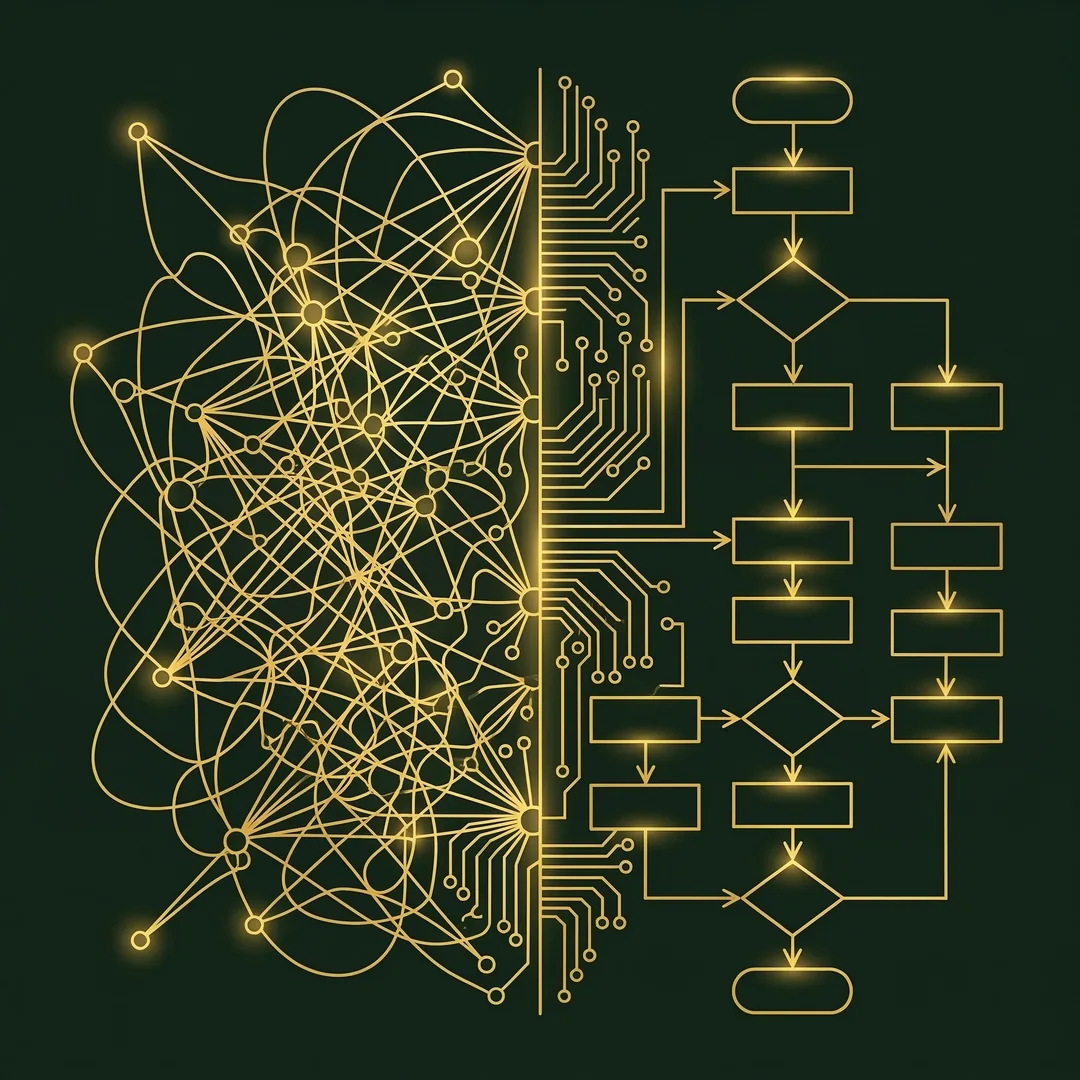
You tried ChatGPT or Claude for a business task. You asked it to write an email, organize data, or draft a proposal. It worked well the first time. The second time too.
But the third time, something went wrong. The wrong format. Missing data. Or an answer that simply made no sense.
This is where many people shrug and say, “AI is not good enough yet.” The reality is more interesting: AI is good enough. It just does not work the way most people think it does. That misunderstanding is why so many people are disappointed by AI, and it is what I want to explain here.
Why does AI give a different answer every time?
AI is not a calculator. Enter a number in an Excel formula and you will always get the same result. AI does not work that way.
It works with probabilities. It does not “know” the answer; it predicts which word is likely to come next, with some randomness involved. Think of asking a very smart colleague a question: you will get a great answer, but if you ask the same question again tomorrow, they will say something slightly different. They will emphasize different points, explain them in a different order, or occasionally skip a step.
That is perfect for creative work. AI is excellent at writing, brainstorming, and research. But problems begin when you expect it to send exactly the same email every time, in the same format, with the same data.
Business logic is deterministic: you need exactly the same result every time. AI, by its nature, is not. The problem lies in that tension.
When AI does everything on its own
According to McKinsey research, generative AI could replace as much as 60-70% of employees’ time. That is a huge number. But there is a condition people discuss less often: it is only true when AI is integrated into workflows correctly.
Consider a simple task. AI has to find a customer’s details, write a personalized email, format the data, and send the message. Four steps.
If it is 90% accurate at each step, which is a very good rate, the overall reliability will not be 90%:
0.9 × 0.9 × 0.9 × 0.9 = 65%
With ten steps, it is 35%. With twenty, just 12%.
This is not theory. It is simple multiplication. The more steps you entrust to AI alone, the more certain it becomes that it will make a mistake in one of them. Not because it is stupid, but because every step carries a little uncertainty, and those uncertainties compound.
That may be acceptable for a hobby project. But when a business processes hundreds of transactions a day, even a 5% error rate is catastrophic: it means constant intervention, loss of trust, and unpredictable service.
You decide, AI assists, code executes
Software development has long followed a principle called separation of concerns. The idea is simple: each component does what it does best.
Applied to AI automation, this creates three roles.
You define the rules, templates, and strategy. You decide how to address your customers, when to escalate, and what counts as urgent. These are human decisions, and they remain so.
AI is excellent at two things: understanding text and recognizing patterns. It can identify whether an incoming message is a complaint or an enquiry. It selects the right template from the ones you defined. It writes the personalized section based on your guidelines.
Actually assembling the email, making the API call, or writing to the database? Traditional program code handles those jobs. Code that does exactly the same thing every time. There is no randomness in it.
Think of it as a good team. You are the owner who sets the direction. AI is the analyst who quickly assesses the situation and categorizes it according to your rules. Code is the operator that carries out the instruction precisely. Everyone does what they do best.
We call this predictable, deterministic automation: a human defines the framework, AI handles the flexible analysis, and code ensures that execution is flawless and consistent every time.
What does this look like in practice?
Take a concrete example: sending follow-up emails to potential customers.
With AI alone: AI writes the email, chooses the subject line, formats the data, and calls the email API. Sometimes it works perfectly. Sometimes it inserts the wrong name, forgets the attachment, or sends the data in a format the system rejects.
With AI + code: AI recognizes which template fits the customer and writes the personalized section. Code inserts it into the template, formats the data, sends the email, and logs the result. The outcome is consistent every time.
This approach is not just more reliable; it is cheaper and faster too. AI processing costs money because text is broken into tokens and you pay for every token processed. Running code is practically free. What is more, AI can spend minutes sorting a data list with its billions of parameters, while a simple program finishes the job in milliseconds. If code can solve the task, there is no reason to use AI.
If AI has disappointed you before
If you felt AI was unreliable, you were not wrong. But AI is not the problem. The approach needs to change.
Today’s leading models, including the Claude, GPT, and Gemini families, already solve complex programming tasks with 80-90% accuracy on independent benchmarks, and other fields are moving in a similar direction. The intelligence is there. The question is how you build the system around it.
That is exactly what we do. We build automations in which you define the rules, AI analyzes, and code executes. If you want to see what that could look like in your business, book a free consultation, and we will show you.
This article was published on the Andronia blog. Andronia helps Hungarian businesses grow with AI automation. Read about our services here.