
The dangers of AI: what is real and what is exaggerated?
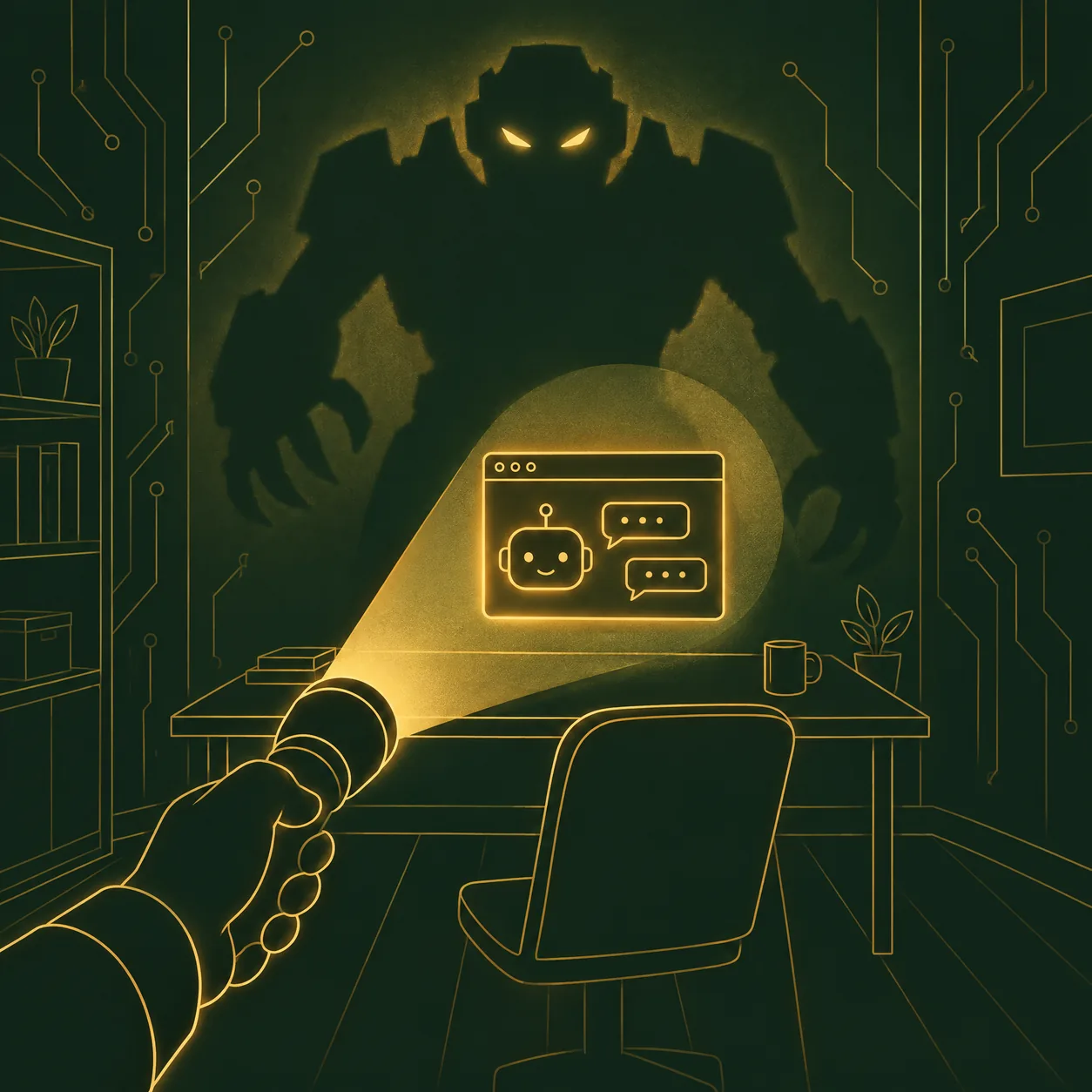
If you’ve read about artificial intelligence lately, chances are you’ve run into some frightening headlines: AI is slipping out of our control, it’s becoming self-aware, it’s taking our jobs, or worse.
The question is fair, and serious experts work on it. In the news feed, though, the most dramatic scenarios get the most attention and the everyday risks get the least. In this article we sort out what’s real, what’s exaggerated, and what’s genuinely worth watching.
We work with AI every day: we build systems with it for our clients, and we do much of our own work with it too. That’s the experience we’re writing from.
Why do we hear so many frightening predictions?
In the competition for attention, a dramatic story always has the edge. A headline saying “everything will be fine” rarely spreads; one saying “we have two years left” spreads far more often.
The topic is also genuinely contested. In 2023, hundreds of researchers and technology leaders, including the heads of the largest AI developers, signed a joint statement saying that reducing the most serious, potentially civilisation-scale risks of AI should be a global priority. Other respected researchers consider those scenarios heavily overstated. So the expert debate is real; it’s mostly the sharpest sentences from it that make the news.
To find your way through it, it helps to understand what actually happens inside an AI system.
How does a language model actually work?
The model is a file. A language model, whether it sits behind ChatGPT, Claude or Gemini, is essentially an enormous set of numbers: billions of values (parameters), tuned during training on vast amounts of text. It has a single job: to predict which piece of text is most likely to follow what it was given. It does this astonishingly well, but what it produces is a response, not an intention.
It only runs when you ask. The model isn’t a thinker running in the background. Every request is a separate calculation: text goes in, a response comes out, and the calculation ends. Between two questions it does nothing, no time passes for it, and it doesn’t keep mulling over what you said. If nobody asks anything, nothing happens.
It doesn’t remember, and it doesn’t learn as it goes. When a chat “remembers” what you wrote earlier, the program is in fact handing it the entire conversation again on every turn. Memory features work the same way: the program saves notes as text and hands them back later. The model itself doesn’t change while in use; its numbers are fixed. Only a new training run gives it new knowledge, and that is started by people, takes weeks or months, and costs a fortune.
An agent is a human-built frame too. There are now agents that work on their own for hours. But what stands behind an agent isn’t the model’s own will. It’s a program written by people that calls the model again and again, and hands it only the tools someone has permitted. Every such session is started by someone, given its task by someone, and paid for by someone, token by token. An agent doesn’t start anything at 3 a.m. that it wasn’t given beforehand. Its autonomy is exactly as large as a person allows it to be.
Can artificial intelligence become self-aware?
This is one of the most common questions, and films don’t help much in answering it.
Most researchers say today’s models are not conscious: they predict text and experience nothing. Whether a future system could ever be conscious is an open question, as much philosophical as technical. There isn’t even agreement on what consciousness exactly is.
From a practical point of view, though, there’s a more important question: what a system is able to do, and who decides that. Today’s AI systems operate within the frame that people set for them. That frame is the real safety question.
What do researchers worry about?
The more serious expert concerns aren’t about consciousness at all. In the philosopher Nick Bostrom’s famous thought experiment, an AI has a single goal: to make as many paperclips as possible. It isn’t evil or conscious, just consistent, and in the end it subordinates everything to that goal. The lesson: a system can cause harm without any self-awareness if it’s given a badly specified goal, too much access, and nobody supervises it.
That’s a serious point. The good news is that all three elements depend on human decisions: what goal someone gives a system, what it’s allowed to access, and how it’s checked. That’s a question of engineering and responsibility, the same kind we deal with for bridges, aeroplanes and nuclear power stations. The EU AI Act is partly about exactly this: for high-risk applications it requires human oversight and documentation.
The real dangers of AI today
The most tangible risks aren’t in the distant future. They’re already here, and they’re caused by people, using AI.
- Scams. In December 2025, Hungary’s central bank (MNB) warned that fraudsters now use AI-generated messages and webshops that are “almost impossible to recognise”. As early as 2024, ESET reported criminals phoning people with the cloned voices of their relatives.
- Careless deployment. A badly configured AI system can leak customer data or give a confidently wrong answer. We’ve written more about this here and here.
- Data protection. Whatever you paste into a public chat is out of your hands. Company and customer data should only go into tools whose data-handling terms you know.
- Work changing. AI will take over some tasks, and that affects certain jobs more than others. It deserves an honest conversation, without scaremongering and without silence.
What can you do?
As an individual:
- Agree on a family password that only you know. If a “relative” phones and urgently asks for money, ask them for it.
- If a message or webshop makes a suspiciously good offer or tries to rush you, check it with an independent source before you pay.
As a business leader:
- Know which AI tools your staff use, and with what data.
- Give an AI system access only to what its task genuinely needs.
- Wherever a mistake affects customers or money, have a person approve the steps.
The dangers of artificial intelligence are real, but most of them are known, everyday and manageable. The best remedy isn’t panic but being informed: once you understand how AI works, it’s much easier to tell when caution is warranted.
If you’d like AI to work safely and within a clear framework at your company, let’s talk.
This article was published on the Andronia blog. Andronia helps businesses grow with AI automation. Read about our services here.